@qkstat/retrieve
pre-release
Exact-retrieval RAG primitives on GPU: cached matmul + fused top-k.
Benchmark: 0.06 ms top-10, recall 1.0 (MS-MARCO, H100)
GPU-accelerated building blocks for AI apps. Currently in technical preview.
Exact-retrieval RAG primitives on GPU: cached matmul + fused top-k. Benchmark: 0.06 ms top-10, recall 1.0 (MS-MARCO, H100)
pre-release
@qkstat/retrieve
MiniLM-L6-v2 embeddings on H100 via MAX + Python interop. Benchmark: 1.44 ms p50 end-to-end, batch-1 seq-32 (H100, synthetic text)
pre-release
@qkstat/embed
Pre-release. Both build from source today with Mojo + pixi.
npm distribution is in progress for @qkstat/retrieve;
@qkstat/embed currently runs in-repo and is not packaged for npm.
Follow the repo for updates.
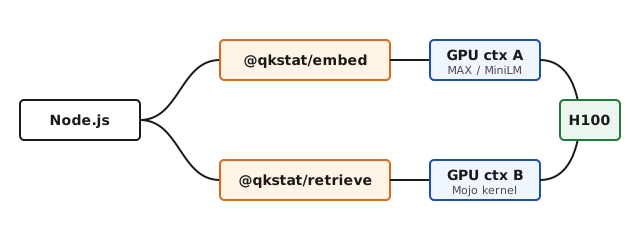
Two Mojo addons load into the same Node process, each with its own CUDA context,
composing at runtime. Neither napi-rs nor a bundled GPU vector DB does this.
@qkstat/embed handles inference (MAX + Python interop);
@qkstat/retrieve handles retrieval (Mojo N-API matmul).
They share a Node runtime but not a CUDA context — which is what makes the composition clean.
Read more about Mojo, or the bridge that makes Mojo-in-Node possible: napi-mojo.